
Published 2014.08.22
Selected as One of Korea's Top 3 Developers
Chairman Kim Hyun-Seok was selected as one of the top 3 representative developers in Korea by Maeil Business News.
Source · 매일경제
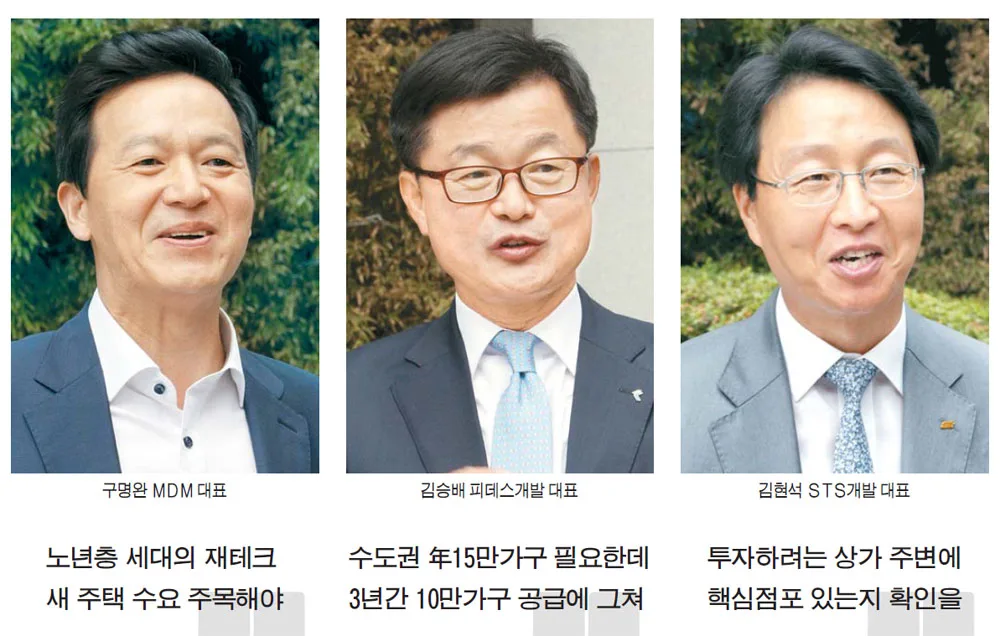
What does the future hold for Korea’s real estate market, and how should investors approach it? Developers create value by identifying promising land and unlocking its potential. Here are the views and forecasts on real estate market trends from three leading Korean developers: Myungwan Koo, CEO of MDM; Seung-bae Kim, CEO of Pides Development; and Hyun-seok Kim, CEO of STS Development. — What are the current trends in income-generating real estate? ▶ Hyun-seok Kim, CEO: The retail market is becoming increasingly polarized between simple street-level shops and large-scale, integrated mall-style developments. Retail investment can be divided into direct investment, where investors assess the income-generating potential themselves, and indirect investment through REITs or funds. If you lack expertise in retail properties, the latter may be a better option. With interest rates remaining low, residential properties are becoming less attractive as investments. Alternative products such as commercial facilities have relatively limited supply while offering strong development potential, so they are likely to generate relatively high returns for the time being. For direct investment, investors should determine whether there is a key tenant, whether nearby parks or development areas such as Yongsan can generate additional foot traffic, and whether surrounding retail sales and asking prices are reasonable. Rather than relying on superficial numerical indicators such as the size of the potential customer base, investors should examine actual sales at nearby stores and whether the property price is appropriate. For indirect investment, investors should select an asset manager that has long-term leases with retail properties featuring strong credit quality and competitive commercial content. — What do you expect Seoul and the greater metropolitan area to look like in the future, and what development trends do you foresee? ▶ Hyun-seok Kim, CEO: In Japan, urban regeneration has involved combining residential, commercial, and office functions while increasing development density. Korea will basically follow a similar development path. In central urban areas, high-density developments capable of generating high added value will emerge. Meanwhile, commercial facilities that do not need to be located in the city center—and can instead be developed on cheaper land farther from the core—will tend to be lower-value developments centered around transit stations. These different types of development are likely to coexist. In fact, Korea has reached the point where developments similar to Toranomon Hills in Tokyo should begin in earnest. Such projects are also necessary from an urban-regeneration perspective. However, regulations are preventing developers from pursuing them. Financing costs are high, and the current development structure requires developers to exit their investments as quickly as possible. As a result, the market does not provide developers with sufficient conditions to create value beyond the basic use value of a property and generate additional investment value. — There is currently a boom among wealthy investors in purchasing small- and medium-sized buildings. Is it worth investing when yields are below 4%? ▶ Hyun-seok Kim, CEO: The building market is also becoming polarized. Rather than investing primarily for capital gains as in the past, the trend is shifting toward wealth management based on stable rental income. Buildings with mediocre locations and mediocre sizes, however, may actually face the possibility of declining asset values. [By Lee Geun-woo and Lim Young-shin]